
 (303) 356-9009

Repast or Repass? Why You'll See Both Spellings
You will see both, and this trips a lot of people up.
Repast is the correct spelling. It comes from the Old French repaistre, meaning to feed or to eat, and it has meant simply "a meal" in English for centuries.
Repass is a common phonetic spelling that developed because the two words sound nearly identical when spoken. It appears frequently in funeral programs, church bulletins, and family group texts, and it's widely understood. It isn't the dictionary spelling, but nobody is going to correct you at a funeral.
If you're printing a program and want the traditional form, use repast.
What Happens at a Repast
The structure is loose by design. Most repasts follow a similar shape:
- Guests arrive from the service, often over the course of 20 to 30 minutes
- Food is set out buffet-style or passed on platters so people can serve themselves
- There may be a short blessing or a few words from a family member, but no formal program
- Guests eat, share stories, and look at photos
- People leave gradually rather than all at once
The point of a repast isn't the meal. It's giving people a reason to stay in the same room a little longer.
What Food Is Traditionally Served at a Repast
Repast food is deliberately unfussy. It should be easy to eat standing up or balanced on a lap, easy to serve without a full kitchen staff, and familiar enough that nobody has to think about it.
Commonly served at a repast:
- Sandwiches and sliders: petite sandwiches on croissants or baguettes are the workhorse of any repast
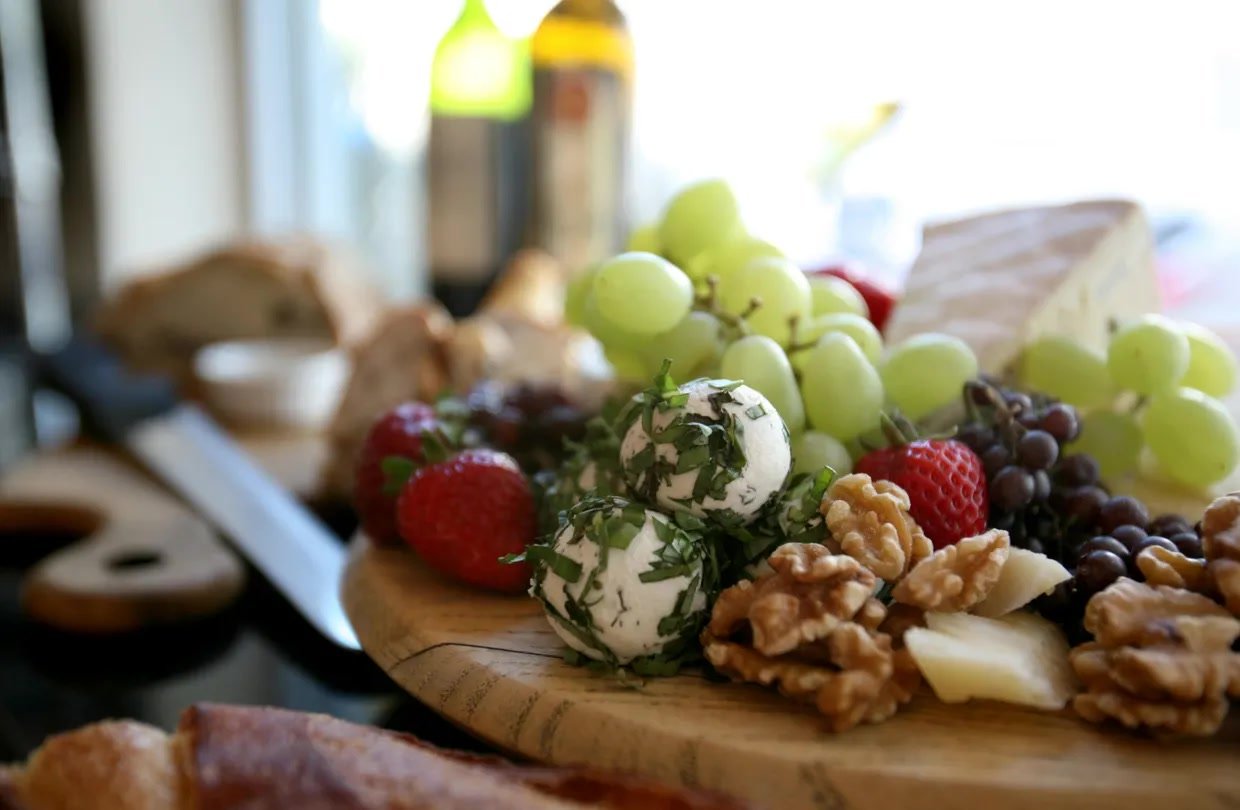
- Cheese, charcuterie, and crudité platters that hold well over a long window
- Cold salads: garden, pasta, potato, and fruit
- A warm item or two if the repast replaces a meal, such as pasta, roasted chicken, or brisket
- Deviled eggs, meatballs, and similar small bites
- Simple desserts: cookies, brownies, mini pastries
- Coffee, iced tea, lemonade, and water
Generally avoided:
- Anything that requires a knife and fork while standing
- Strongly spiced or unfamiliar dishes
- Elaborate plated courses, which shift the tone from gathering to event
- Heavy alcohol service: many families serve none at all, and beer and wine only if they do
One note on dietary needs. Funerals gather people from every corner of someone's life, and you won't have time to poll them. Two or three vegetarian and gluten-free options on the table handles almost everyone without anyone having to ask.
An Example Repast Menu
Here's what a straightforward afternoon repast looks like for 30 guests, built from our platter menu. Prices are current published platter pricing; every platter serves 15, so most items appear twice for a group this size.
| Item | Serves | Price |
|---|---|---|
| Petite Sandwiches: Waldorf Chicken Salad with Walnuts, Grapes & Apple | 15 | $127.50 |
| Petite Sandwiches: Roasted Turkey, Bacon & Farmhouse Cheddar | 15 | $127.50 |
| The Artisan Cheese Platter (VEG) | 15 | $172.50 |
| Farm Fresh Vegetable Crudité (VEG, GF) | 15 | $127.50 |
| Devilish Eggs: Dill & Capers (GF) | 15 | $52.50 |
| Assorted Mini-Desserts | 15 | $52.50 |
| Gourmet Cookies and Double Fudge Brownies | 15 | $52.50 |
| Eco-Friendly Disposables | 30 settings | $67.50 |
| Total | 30 guests | $780.00 |
That works out to roughly $26.00 per guest for a light afternoon repast, served on eco-friendly disposables with no staffing required.
If the repast is standing in for a meal, add a warm item. Our San Marzano Pasta Table (house-made San Marzano tomato sauce over cavatappi, meatballs served alongside, chicken parmesan, Caesar Salad, and French Bread & Butter) is the most-requested option for exactly this situation. Full-service menus like this one are quoted per person and carry a 15-guest minimum.
If you need chafers to hold warm food, our Simple Disposable Chaffer Package is $14.25 and the Elevated Chaffer Package is $33.00.
If guests are traveling or arriving at different times, Individual Charcuterie Boxes at $15.25 each (15-box minimum) let people eat whenever they arrive without a buffet line.
What Repast Catering Actually Involves
Repast catering is a narrow job with a few specific demands, and it is not the same as catering a party. The food has to arrive ready, hold for two to three hours without attention, and be served in a room where nobody is thinking about logistics. Most caterers who do a lot of it settle into the same approach.
Funeral repast catering is almost always ordered on two to four days' notice. Caterers who handle repasts regularly keep the lead time short on purpose, because families do not get to plan around a death. If you are calling about catering for a repast this week, say so in the first sentence. It changes which menus are on the table and nothing else.
The three service levels, and what each one really means:
Drop-off repast catering. Platters are delivered set up and ready to serve, with disposables if you need them. You handle the rest. This is the most common choice for a church hall or a smaller gathering, and it is the cheapest way to feed a room well.
Delivery with setup. The caterer arranges the table, sets out serving pieces, and leaves. Useful when nobody in the family wants to be the one assembling a buffet an hour after a burial.
Full-service repast catering. Staff stay on site to replenish platters, clear plates, and break the table down. Worth the cost when the immediate family will be at the repast. Nobody should be carrying an empty tray back to the kitchen at their own mother's repast.
What a repast caterer should ask you. A caterer who does this often will ask about the venue's kitchen and refrigeration, the service end time rather than the start time, who will be on site to let them in, and whether you need serviceware. If they ask only for a headcount and a budget, they do not do many repasts.
Repast Catering Costs
For a platter-style repast with no staffing, expect roughly $25 to $30 per guest, which is what the 30-guest example above works out to. Published platter pricing runs $3.50 to $18.25 per person with a 15-serving minimum per item, and eco-friendly disposable place settings are $2.25 per setting.
A repast luncheon with warm food costs more, because you are adding both the food and a way to hold it. The Simple Disposable Chaffer Package is $14.25 and the Elevated Chaffer Package is $33.00. Full-service repast catering, with staff on site, is quoted per person.
The lever that moves cost most is service level, not menu. If your number is fixed, change from full service to drop-off before you change what is on the table. A generous platter spread you set out yourself feeds more people for the same money than a thinner menu with staff.
Repast Catering in Denver
We cater repasts, funeral luncheons and mercy meals across the Denver metro area, at funeral homes, church and community halls, event venues and family homes. Menus start at a 15-guest minimum, so a small family gathering is as welcome as a full hall. If you tell us the venue, we will call them about timing, kitchen access and parking so your family does not have to.
Still deciding the menu? Our guide to what to serve at a funeral reception covers the food side in detail, and the planning steps below walk through the rest. When you are ready, book a free planning consultation and we will take it from there.
How to Plan a Repast
Most families are planning a repast on two or three days' notice, in the middle of everything else. This is the order that causes the least stress.
Step 1: Pick the Location Before the Menu
A church hall, a private room at a restaurant, or someone's home all impose different limits on what you can serve. Kitchen access, refrigeration, and whether you can leave food out determine the menu more than taste does.
Step 2: Estimate Guests Generously
Repast attendance is unpredictable: people who skip the service often come to the meal, and vice versa. Take your expected number and add 20%. Running out is the one outcome families genuinely regret.
Step 3: Choose Room-Temperature-Friendly Food
Guests arrive over a long window. Food that's still good 90 minutes after it's set out spares you from managing the table all afternoon.
Step 4: Decide Drop-Off or Full Service
Drop-off catering is delivered set up and ready, and you handle the rest. Full service means staff on site to replenish, tidy, and break down. If the immediate family will be at the repast, full service is worth it: nobody should be refilling a platter at their own mother's repast.
Step 5: Hand Off the Logistics
Delivery time, setup location, and headcount are worth confirming once in writing and then not thinking about again. A caterer who does this regularly will ask you the questions you haven't thought of.
Who Pays for the Repast?
Traditionally the immediate family hosts and pays for the repast, and it's often folded into the overall funeral budget alongside the service and burial.
In practice it's frequently shared. Extended family commonly contributes, a church congregation or fraternal organization may host the meal as part of their ministry, and close friends often ask to cover a specific piece of it. If someone offers, letting them handle the desserts or the beverages is an easy way to say yes.
Guests are not expected to pay or to bring food to a repast. That distinguishes it from a potluck-style gathering, where the food is contributed. If a family does want guests to bring dishes, that needs to be stated explicitly: otherwise people will arrive empty-handed and correctly so.
Repast vs. Celebration of Life vs. Wake
These get used interchangeably and they aren't the same thing.
| When it happens | Tone | Food | |
|---|---|---|---|
| Wake / Visitation | Before the funeral service | Somber, receiving guests | Light refreshments, sometimes none |
| Repast | Immediately after the service | Informal, gathered | A hosted meal or substantial spread |
| Celebration of Life | Days to months after, sometimes instead of a funeral | Warmer, more personal | Anything from appetizers to a full meal |
A family may hold all three, or only one. A celebration of life held right after a service is functionally a repast; a celebration of life held six weeks later is its own event with its own planning.